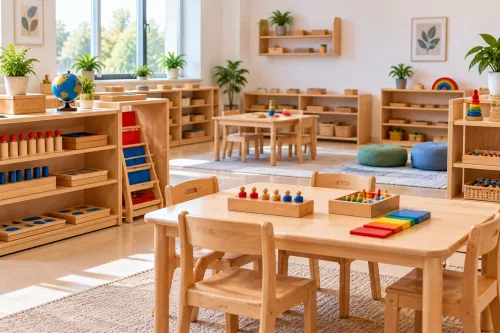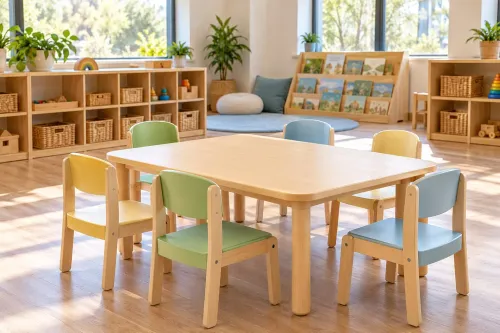
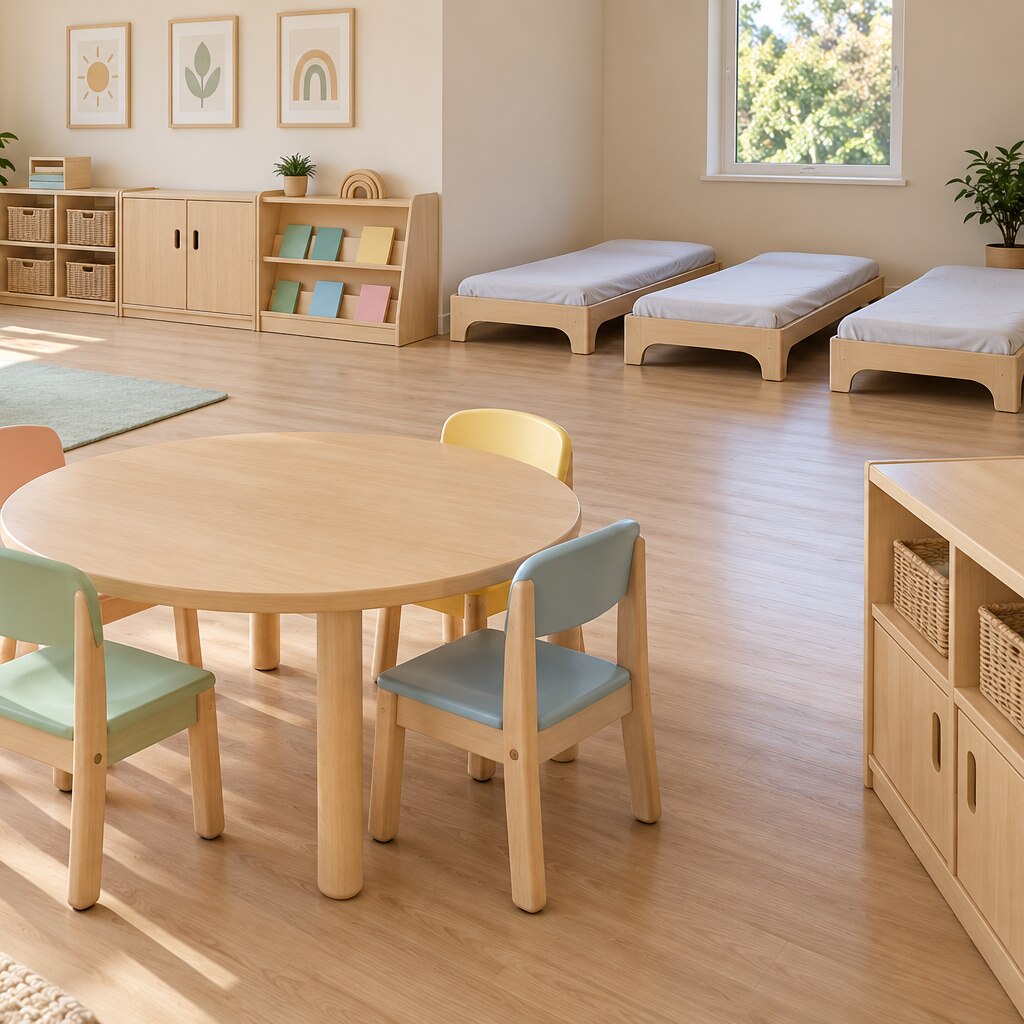
A daycare room must let children move, eat, sleep, and access materials without crossing one another’s paths or creating avoidable hazards. By the end, you will have a practical way to zone the room, measure it, match furniture to age and ability, and check whether a product is suitable for all-day daycare use.
Key takeaways
- Keep main circulation paths at least 900 mm wide.
- Separate infant sleep areas from supervised floor play.
- Choose furniture with stable bases, no entrapment gaps, and cleanable surfaces.
- Specify furniture for continuous, unsupervised daily use.
Build Four Zones Without Crossing Traffic
Start with a continuous circulation path around four fixed activity zones, not a route that cuts through them. Use 900 mm as a planning minimum for main paths, and keep doorways, exits, and staff sightlines clear.
- Active play area: Place it in the largest open section, away from meal tables and sleep surfaces. Leave clear floor space around climbing, pushing, and rolling equipment so children cannot launch into furniture or cross another zone.
- Meals: Put tables near the handwashing point and away from the play route. Allow space behind pulled-out chairs so children do not squeeze between seated children and moving equipment.
- Rest: Position cots or sleep products in the quietest, least visible-through-traffic corner. Separate infant sleep furniture from nap mats and supervised floor play; infants need a firm, flat, non-inclined sleep surface in a compliant crib, bassinet, or play yard.
- Storage: Keep daily-use items in low, stable units at the edge of the room. Anchor tall cupboards, lock casters on movable units, and avoid placing shelves where children must pass behind them to reach another zone.
Your daycare furniture plan should preserve direct circulation paths between the entrance, handwashing area, meals, and exits. Label and assign mats or cots, then store them without sleeping surfaces touching. Choose open cubbies for supervised self-selection, but use smooth, cleanable surfaces and enclosed cupboards for supplies that need dust and spill protection.
Avoid placing storage between staff and the active play area.
Measure the Room and Match Furniture to Children
Measure the room in centimetres before choosing daycare furniture dimensions. Record wall lengths, door swings, columns, radiators, outlets, floor transitions, and the clear route between activity areas. Draw the usable floor area, not the room’s nominal size.
1. Measure each child’s popliteal height: the distance from the floor to the underside of the knee when seated. Use it to select seat height so both feet rest on the floor or a footrest. Measure hip width, seated knee height, and thigh thickness for chair width and table clearance.
2. Match chairs and tables as a set. Measure table height against seated elbow height, then confirm that knees fit beneath the tabletop without contact. A child perched on an adult chair or sliding forward at meals has lost stable support.
3. Measure reach before ordering storage. Set shelf height so children can retrieve permitted materials without climbing; reserve higher shelves for staff supplies. Check the deepest shelf and the distance from the circulation path, since a low shelf improves access but consumes floor space.
4. Measure approach space for every user, including a wheelchair, walker, or transfer beside a chair. Check table clearance, armrests, seat height, turning room, and reach against the actual mobility aid. A fixed-height table may simplify maintenance; an adjustable one needs guarded pinch points and regular lock or gas-strut checks.
Use a child sample from each age group rather than one “average” measurement. Ask the supplier for seat height, table height, shelf height, clear knee space, overall depth, and installed footprint; then test a full-size sample with the children who will use it.
Separate Infant Sleep From Supervised Floor Use
An infant who sleeps on a nap mat or soft play surface is not using compliant infant sleep furniture. Provide a firm, flat, non-inclined crib, bassinet, or play yard; place the baby on the back with no pillow, blanket, bumper, or loose bedding.
| Age group | Appropriate rest furniture | Appropriate play and meal furniture |
|---|---|---|
| Infants | Full-size cribs meeting 16 CFR Part 1219, or non-full-size cribs meeting 16 CFR Part 1220 | A firm floor area for supervised play; use high chairs meeting ASTM F404 for meals |
| Toddlers | A compliant crib until the child is ready to transition, then a toddler bed covered by 16 CFR Part 1217 | Low, stable tables and chairs matched to the child’s feet and seat height |
| Preschoolers | Assigned nap mats and cots, spaced apart during use and storage | Child-size tables and independent chairs for play, eating, and quiet work |
| Mixed-age groups | Separate infant cribs from toddler beds, nap mats, and cots; never use one sleep product for every age | Create age-specific floor areas and keep older children away from infant sleep equipment |
A product sold as a “daycare crib” is not automatically compliant. Ask for the applicable standard, test documentation, and model identification before ordering.
Label each nap mat and cot, and store them so sleeping surfaces do not touch. Require a documented cleaning method for the cover; “wipe-clean” does not prove resistance to disinfectants. For children who can sit safely, a low table and independent chair reduce restraint-related risks, but demand closer meal supervision.
Check Stability, Entrapment, Materials, and Cleanability
Approve furniture only after inspecting the exact model, accessories, and installed configuration. A brochure will not reveal a loose caster, an exposed staple, or a joint that traps food.
1. Test tip-over resistance with drawers and doors loaded as they will be used. Push from several sides and check what happens when a child climbs, pulls, or pushes. Tall, child-accessible storage needs wall anchoring; otherwise replace it with a low, stable unit.
2. Run your hand over every edge and corner. Look for rounded corners, a consistent edge radius, secure edge banding, and no splinters, cracks, sharp hardware, or exposed fasteners. Rounded corners alone do not prevent injury.
3. Inspect openings, gaps, hinges, lids, sliding parts, folding frames, and adjustable mechanisms for head-and-neck entrapment, finger-pinch points, and shear or crush points. Operate each part repeatedly, including locks and gas struts, and reject anything that closes suddenly or leaves a child’s finger trapped.
4. Check mobility controls before purchase. Casters need positive locks; permanently mobile units must be light enough for staff to move without unsafe lifting. Confirm that locks hold on the actual floor surface.
5. Demand documentation for the supplied finished product and its components, including PVC parts, soft bumpers, finishes, and casters. For US purchases, verify lead and specified phthalate limits under Consumer Product Safety Improvement Act rules.
6. Wipe every surface with the daycare’s disinfectant. Choose sealed, non-absorbent surfaces, closed seams, washable covers, and no exposed foam or fabric that retains spills. Reject furniture with dirt-trapping recesses or surfaces the cleaner damages.
Specify Furniture for Unsupervised, All-Day Use
A reading nook built for short, supervised sessions is not automatically suitable for daycare furniture procurement. For unsupervised, all-day use, compare the supplier’s evidence for stability, cleaning, wear, and child access—not just the appearance or comfort.
| Option | Suitable for supervised reading | Suitable for all-day daycare use |
|---|---|---|
| Low reading bench | Yes, when adults control use and inspect it regularly | Only if edges, upholstery, fixings, and cleanability are documented |
| Tall bookcase | Only when staff prevent climbing | Choose a low unit, or anchor it to the building and test it fully loaded |
| Soft seating | Comfortable but vulnerable to stains, torn seams, and exposed foam | Require sealed covers, approved cleaning chemicals, replacement covers, and fire-test details |
| High chair | Not relevant to reading | Require ASTM F404 documentation, working restraints, stable legs, and secure tray attachment |
Ask each supplier for model-specific documents, not a general statement that products meet CPSC compliance requirements. The file should identify the actual finished product or component and address lead and specified phthalate limits in finishes, edge banding, PVC parts, casters, and bumpers.
Require an installed-configuration tip-over assessment that includes loaded drawers and doors, anchoring hardware, and child-accessible shelves. A unit that passes empty can overturn after a child climbs it.
For infant sleep, request the applicable 16 CFR Part 1219 or 16 CFR Part 1220 documentation; “daycare crib” is not a compliance standard. Arko Global is worth comparing when its layout proposals show how reading furniture avoids becoming a climbing route or blocks staff sightlines.
Related products
 | KINDERGARTEN TABLES The XOXO Reading Nook is the perfect element to include into any classroom that needs a quiet reading space. View product → |
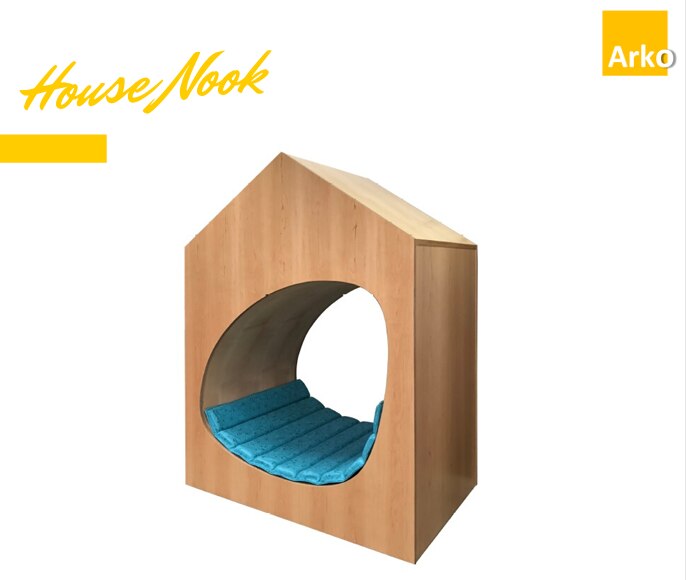 | KINDERGARTEN TABLES A cozy place to read a book alone or with a friend. Colorful fabric an finish options can really brighten up library or school spaces and make it... View product → |
Frequently asked questions
How wide should main daycare circulation paths be?
Use 900 mm as a planning minimum for main paths, and keep doorways, exits, and staff sightlines clear.
How should you arrange daycare furniture into activity zones?
Create fixed play, meal, rest, and storage zones around one continuous circulation path instead of cutting routes through activities.
What safety features should daycare furniture have?
Check stability, remove entrapment hazards, use suitable materials, and confirm that surfaces and joints can be cleaned thoroughly.
Should infant sleep furniture share space with floor-play equipment?
Separate infant sleep from supervised floor use so active play, movement, and storage do not disrupt sleep or supervision.
Related products
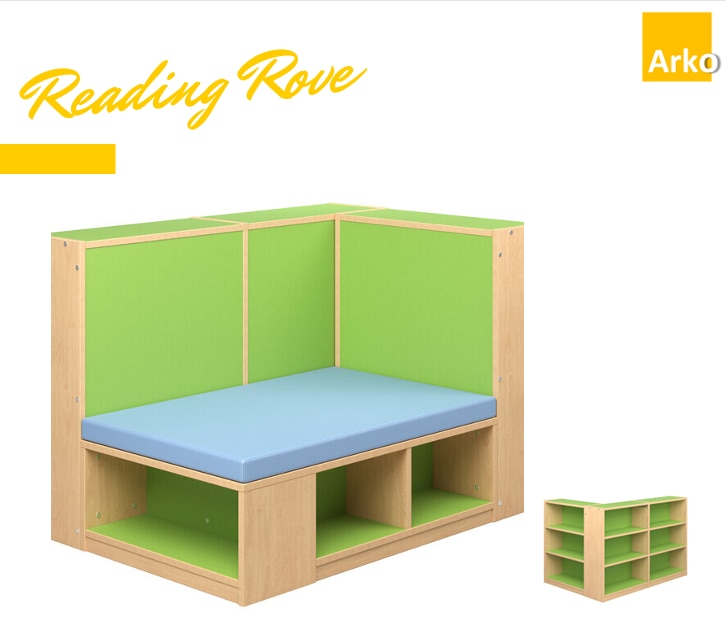 | KINDERGARTEN TABLES After picking out a book, you need to find a comfortable place to enjoy it. View product → |
 | SHAPES / LAYOUTS Arko Global is one of the leading manufacturers of kindergarten shapes and layouts in Bangalore, specializing in creative, safe, and child-friendly... View product → |