A school laboratory needs more than tables that fit the room: surfaces must withstand the work, storage must control risk, and utilities must remain safe when pupils are moving around them. By the end, you will be able to compare furniture specifications, identify missing supplier information, and test whether a proposed layout suits your students, experiments, and cleaning routine.
Key takeaways
- Assess benches, stools, storage, sinks, utilities, and supervision as one system.
- Compare chemical resistance, cleanability, impact strength, and repairability—not appearance alone.
- Specify stable frames, rounded edges, safe clearances, and tamper-resistant electrical access.
- Request drawings, material data, load ratings, warranty terms, and installation records.
What Counts as School Lab Furniture, and Which Categories Must You Assess?
A practical school lab furniture definition is the fixed, movable, and service-supporting equipment that enables teaching, experiments, storage, cleaning, and supervision. Assess the room as one operating system, not as separate products.
Start with an occupied floor plan showing stools pushed out, backpacks under tables, open cabinet doors, carts in use, and pupils gathered around a demonstration. Require a taped floor plan or full-scale mock-up before approving dimensions. Deeper worktops hold more apparatus but reduce circulation and sightlines.
Assess these categories together:
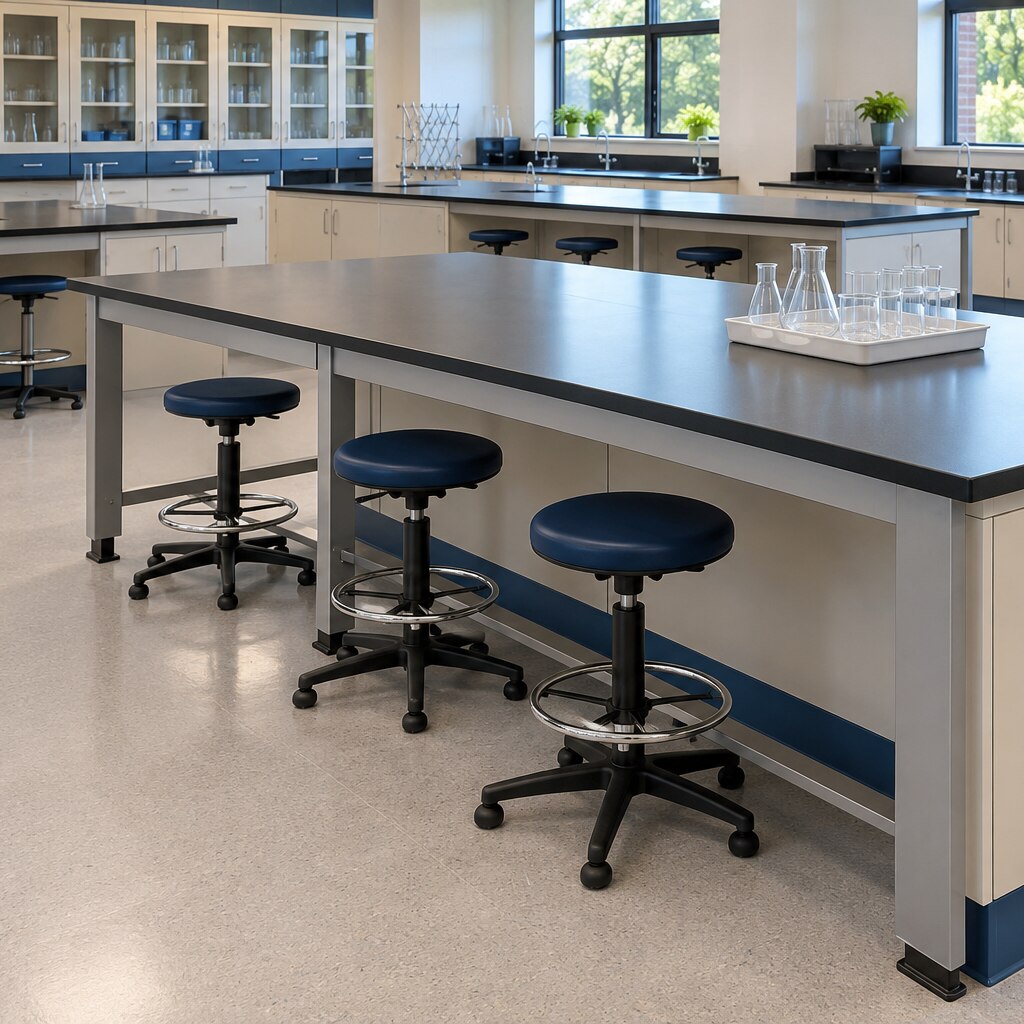
- Laboratory worktables for student experiments, demonstration tables for teacher-led work, teacher stations, stools, and mobile units.
- School laboratory sinks and cabinets, including wet-work stations, storage cabinets, and lockable chemical cupboards.
- Mobile units with defined parking positions, locking casters, cable management, and storage for loose equipment.
| Category | Check during planning | Common failure |
|---|---|---|
| Fixed | Age range, experiments, class size, supervision points | Dense casework blocks movement and sightlines |
| Mobile | Parking, braking, stability, cables, nested storage | Units roll, tip, or leave equipment exposed |
| Accessible | 30-inch minimum clear width, 48-inch minimum clear length for forward approach, plus knee and toe clearance | A pedestal, modesty panel, bin, or leg brace removes the clearance |
State whether each item will be fixed, mobile, or nested. Specify tabletop height separately from clear floor space, and test stools for supported feet and elbows near work-surface height. Mobile furniture improves reconfiguration only when its movement and storage rules are designed in advance.
How Should You Compare Laboratory Work-Surface Materials?
Choose a work surface by the substances, temperatures, tools, and cleaning agents it will encounter—not by the label “chemical resistant.” Request a documented test such as SEFA 8M, including the tested substrate, finish, reagent list, exposure time, and pass/fail criteria.
| Material | Strengths | Limits |
|---|---|---|
| Compact laminate laboratory tops | Dense, durable, suitable for general science and wet work | Damaged edges and joints admit water; not automatically suitable for aggressive reagents |
| Epoxy resin worktops | Strong resistance to water, acids, alkalis, solvents, stains, heat, and scratching | Cost, weight, and installation demands can be excessive for low-risk activities |
| Phenolic resin laboratory surfaces | Lighter and practical for many classroom applications | Resistance depends on grade and reagent exposure |
| Stainless steel lab tables | Handles water, impact, and heat well | Scratches, fingerprints, harsh chemicals, and corrosive agents remain concerns; glare can hinder viewing |
| Hardwood | Warm, repairable surface for selected physics or general-science activities | Poor for prolonged wet work, acids, solvents, or repeated disinfection without proper protection |
| Standard commercial laminate | Suitable for dry, low-risk work | Decorative layers, seams, and substrates are vulnerable to heat, moisture, solvents, and concentrated reagents |
Test the surface and its edge seals, powder coatings, and printed markings against the school’s actual cleaning regime. Use the exact concentration, dwell time, and cleaning frequency for diluted bleach, quaternary-ammonium disinfectants, alcohols, and abrasive cleaners; a short spot test can miss damage from repeated exposure.
Ask the supplier to document:
- Compatibility with the selected reagents and cleaners
- Resistance after the stated exposure time, including visible change and loss of function
- Performance at joints, cut edges, seams, and around sinks
Which Frame, Stability, and Student-Safety Features Matter?
Choose a frame that stays rigid under real classroom loads, not just an empty showroom test. Welded laboratory frames reduce assembly variables and often improve rigidity; knock-down lab furniture travels and replaces easily but depends on reliable fasteners and inspection after assembly.
| Construction | Advantage | Risk to verify |
|---|---|---|
| Welded frame | Fewer joints and strong rigidity | Weld quality, corrosion protection, repair access |
| Knock-down frame | Easier transport and replacement | Loose fasteners, joint movement, assembly errors |
Specify steel gauge and load capacity, joint design, corrosion protection, uniformly distributed load, concentrated-load capacity, deflection limit, and caster rating. State whether every rating applies when the table is stationary, mobile, or nested; casters and uneven floors reduce practical capacity.
- Require adjustable levelling feet that remain stable under load and conceal sharp threaded ends.
- For mobile units, specify at least two lockable casters or an equivalent positive brake, a defined locked position, floor-finish rolling resistance, and stability when pupils lean, pull, climb, or load one side.
- Inspect corner radius, edge hardness, exposed metal, leg ends, hinge pinch points, protruding handles, and hazards at head and shoulder height—not rounded corners alone.
- Provide stools with non-slip feet and a seat height suited to the table.
For adjustable laboratory tables, record minimum and maximum heights, adjustment increments, pinch-point protection, and stability at full height. Preserve supported feet and elbows near work-surface height for the actual age range. Keep aisles clear after stools, bags, open doors, and protruding furniture are included.
How Should You Specify Storage, Sinks, Utilities, and Electrical Safety?
Specify storage and utilities as installed safety systems, not as cabinet add-ons. Chemical storage cabinets need locks, segregation for incompatible chemicals, ventilation for volatile substances, and a separate spill tray or bund; a cabinet base alone is not spill containment.
1. Define access and retention. Keep hazardous and teacher-controlled materials in enclosed storage. Store frequently used classroom items within the intended age group’s reach, and secure glassware and equipment against falling.
2. Choose visibility without creating exposure. Open shelves help pupils see supplies but collect dust and expose them to chemicals, glass, and small parts. For each drawer unit, state maximum extension, interlock behavior, anti-tip hardware, anchoring method, wall condition, and operating load per drawer. Treat tall or drawer-heavy units as anchored systems, not freestanding cabinets.
3. Write laboratory sink specifications that name the bowl material, depth, splash control, drain arrangement, leak-resistant joints, and water-resistant cabinetry. Check how the sink connects to waste and supply lines; inaccessible joints turn a small leak into damaged casework.
4. Position gas and electrical service points beyond easy pulling or striking, while keeping shut-off controls accessible to staff. Separate sockets from sinks and wet-process areas. Specify protected sockets, residual-current protection where installed, isolation switches, protected cable routes, strain relief, replaceable modules, and inspection access.
Require records for earthing, insulation resistance, polarity, and residual-current protection where installed. A qualified electrical professional must verify the installation against local requirements, including IS 732 where applicable. School lab electrical safety also means rejecting loose extension cords across circulation paths; floor boxes and table power modules need protection from trips, spills, and contamination.
What Evidence Should You Request Before Approving a Supplier’s Specification?
Approve a supplier only when each claim becomes a measurable requirement backed by evidence for the assembled furniture. A school lab furniture specification checklist should form part of your laboratory furniture procurement file.
Request:
- The exact work-surface chemical test report, including substrate, reagents, concentration, dwell time, and pass/fail criteria.
- Uniformly distributed load, concentrated-load, deflection, caster, and brake ratings, stating whether they apply when stationary, mobile, or nested.
- Frame material, steel gauge, joint construction, corrosion protection, levelling-foot details, and the anti-tip method.
- A dimensioned utility layout showing sockets, sinks, service points, cables, isolation switches, and emergency shut-offs.
- Cleaning-compatibility data for the district’s actual bleach, quaternary-ammonium disinfectant, alcohol, and abrasive-cleaner concentrations, dwell times, and cleaning frequency.
For low-emitting interiors, request product-specific UL GREENGUARD Gold furniture certification covering the finished desk or cabinet, including adhesives, edge banding, backers, and finishes. Request TSCA Title VI panels documentation for the actual composite-wood panels and finished product where indoor-air requirements apply.
Fixed and mobile furniture suit different teaching models:
| Option | Benefit | Evidence or control needed |
|---|---|---|
| Fixed casework | Maximises apparatus capacity and reduces movement | Anchoring, aisle clearance, and supervision sightlines |
| Mobile units | Supports reconfiguration | Positive brakes, parking positions, cable control, and off-centre-load stability |
Have an electrical professional review service layouts and test records. Use a full-scale mock-up to check aisle widths, accessible knee and toe clearance, demonstration sightlines, stool parking, door swing, and emergency-shut-off access.
Arko Global is worth considering only if it supplies this documented layout and installation evidence; reject “durable” or “compliant” without a named test, rating, scope, or condition.
Frequently asked questions
What counts as school lab furniture?
School lab furniture includes fixed and movable benches, stools, storage, sinks, service panels, and equipment that supports experiments, cleaning, storage, and supervision.
How should you compare laboratory work-surface materials?
Compare each material’s chemical resistance, water absorption, heat tolerance, scratch and impact resistance, cleanability, joint design, repair options, and replacement cost.
Which frame and student-safety features matter most?
Look for stable frames, level-adjustable feet, rounded edges, secure connections, controlled clearances, tip resistance, and layouts that let teachers supervise every work area.
What should you specify for storage, sinks, utilities, and electrical safety?
Specify lockable storage, accessible sinks, splash-resistant fittings, clearly identified utility points, protected cables, residual-current protection, and electrical outlets positioned away from wet zones.
What evidence should you request from a school lab furniture supplier?
Request scaled layout drawings, material and finish data, load ratings, installation details, cleaning instructions, warranty terms, maintenance requirements, and documented safety or performance test results.